

Table of Contents
- What Makes a Leather Belt Durable Enough for Work?
- Quick Picks:
- Best Durable Leather Belt for Work: Our Top Picks
- Full Grain Leather Belt Benefits for Job Sites
- How to Measure for a Work Belt That Fits Right
- How to Maintain Leather Work Belts for Years of Use
- Signs of a Cheap Belt and What to Avoid
- The Bottom Line on Buying a Work Belt
- Frequently Asked Questions
Last Updated: September 5, 2026
What Makes a Leather Belt Durable Enough for Work?
A durable leather belt resists stretching, cracking, and hardware failure under daily physical stress. For tradespeople, it is load-bearing equipment that holds up heavy tool pouches and takes repeated abuse against scaffolding, workbenches, and machinery.
Work belts rarely snap in half; they fail when holes stretch out, the buckle bends, or leather cracks along the hip bend. Understanding these failure points separates a belt that lasts a decade from one that dies in eighteen months.
This guide covers what makes a genuine work belt, our top picks, and how to keep yours functional for years.
Three factors decide whether a leather belt survives real work: hide quality, tannage, and hardware. Full-grain leather retains the dense fiber structure that gives tensile strength; top-grain has this layer sanded down. Genuine or bonded leather is typically split leather with a thin coating and will not survive daily work use.
Quick Picks:
Best Durable Leather Belt for Work: Our Top Picks
Hide & Hem, LLC builds belts specifically for comfort, fit, and durability in daily use. The full-grain construction means the belt breaks in rather than breaks down, conforming to your body while maintaining its structural integrity.
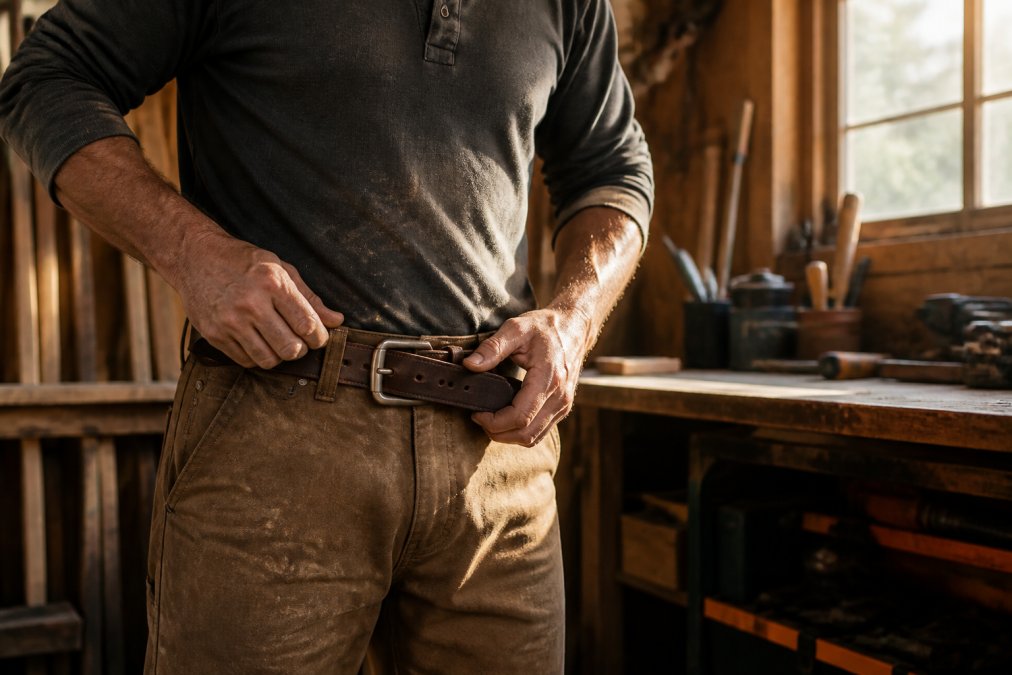
Work belts should be cut from 10-14 ounce leather (roughly 4-5.5 millimeters thick), providing the rigidity to support tool pouches without folding or curling (leathercraftmasterclass.com).
Construction matters as much as the leather. Look for riveted or double-stitched attachments at the buckle point, where most failures occur; a single stitch line through thin leather pulls apart under load.
Full Grain Leather Belt Benefits for Job Sites
Full grain leather belt benefits include superior abrasion resistance, natural moisture management, and a custom fit over time. The intact grain structure resists scrapes from tools, concrete, and metal edges.
Vegetable-tanned leather hardens over time, molding to your body while becoming more rigid; chrome-tanned leather stays softer but stretches more under load. For work belts, vegetable tanning is the traditional choice because it holds its shape and supports weight better.
Edge finishing determines long-term durability. A quality belt has smooth, sealed burnished edges; raw edges absorb moisture and sweat, causing delamination and fraying. Run your finger along the edge, rough or fuzzy signals poor finishing.
The break-in period for a full-grain work belt takes one to two weeks of daily wear, softening at flex points while maintaining stiffness where needed. Customer feedback on Hide & Hem, LLC belts echoes this: one reviewer noted the belt "fits right and feels durable," while another appreciated that it "doesn't feel cheap like others I've tried."
How to Measure for a Work Belt That Fits Right
Measuring for a work belt differs from a dress belt because work belts sit lower on the hips and need room for tool pouches. Measure a belt you already own that fits well, from your usual hole to the end of the buckle.
The center hole sizing method is most reliable: put on the pants you'll wear, measure around the waistband where the belt sits, and add two inches. A belt ordered at your pant size is typically too short because sizing includes the buckle and leather past the holes.
Measurement Point |
What to Do |
Why It Matters |
|---|---|---|
Existing belt |
Measure from your usual hole to buckle end |
Accounts for actual fit preference |
Waistband |
Measure where belt sits on work pants |
Work pants sit lower than dress pants |
Tool pouch allowance |
Add 1-2 inches if carrying pouches |
Prevents belt from being too tight |
Center hole |
Choose belt so middle hole is your fit |
Allows adjustment for layers |
For work, the belt should sit at your natural waist or slightly below. Too tight restricts bending and lifting; too loose lets pants sag under tool weight. It should feel snug but allow two fingers between belt and waist.
How to Maintain Leather Work Belts for Years of Use
Work belts fail because sweat and abrasive grit attack specific stress points. A belt that lasts a decade is maintained with an understanding of where and why breakdown happens.
The Failure Mechanism: Sweat, Grit, and Flex Fatigue
Leather fails from the inside out. Sweat salts crystallize as they dry, cutting fibers when the belt flexes; job-site grit embeds in the grain and works deeper with every bend. Over months, this weakens the leather at flex points: the hips, the buckle bend, and the holes you use most.
A belt often looks fine on the surface but has lost internal tensile strength. The first sign is a permanent curl at the hip bend, followed by hole elongation; by the time surface cracking appears, the internal structure is already compromised.
The Weekly Routine: Grit Removal First
A dry brush or cloth wipe after each shift removes abrasive particles before they embed. Use a soft-bristled brush to sweep grit from the grain and edges, especially where the belt rubs your pants and around the buckle where sweat pools.
Once a week, wipe with a slightly damp cloth to remove sweat salts, then air dry completely. Never use saddle soap weekly, it strips oils; reserve it for deep cleaning every few months or after heavy contamination.
The Monthly Routine: Conditioning with Purpose
Conditioning replaces natural oils stripped by sweat and washing. Neatsfoot oil penetrates deeply but overuse makes a belt too supple; beeswax-based conditioners sit closer to the surface, creating a water-resistant barrier while maintaining firmness.
For a work belt that must stay stiff enough to support tool pouches, apply a light wax-based conditioner every four to six weeks. Let it absorb for 15 minutes, then buff with a dry cloth. Avoid heavy oils that turn leather floppy, you want supple flex points, not softness throughout.
The Heat and Water Rules
Heat is the silent killer, leaving a belt in a truck cab or near a heater dries it out, causing brittleness and cracks. Water accelerates breakdown of tanning agents, especially in chrome-tanned leather. If soaked, air dry away from heat and sunlight, then condition before wearing.
Hardware Maintenance: The Overlooked Component
The buckle and holes are the highest-stress points. Solid brass buckles resist corrosion but accumulate grit in the hinge and prong; a dry wipe and an occasional drop of light oil keeps hardware moving smoothly.
Steel buckles, especially plated ones, can flake and rust. If you see rust transfer on clothing, replace the buckle before it stains pants. Choose a belt with a replaceable buckle, since a quality full-grain belt will outlast several.
The Rotational Strategy
Even the best-maintained belt needs rest. If you wear a belt daily, rotate between two belts to give each 48 hours of recovery, allowing moisture to evaporate and fibers to relax. This simple practice extends belt life significantly.
Signs of a Cheap Belt and What to Avoid
The clearest sign of a low-quality belt is the price-to-construction mismatch. Bonded leather, made from fibers glued with polyurethane, delaminates within months of work use. Split leather, cut from beneath the grain, lacks tensile integrity for load-bearing applications.
Failure Analysis: Why Belts Actually Die
Understanding these patterns tells you what to inspect before buying, and what will kill a belt on the job.
Stress Point 1: The Buckle Hole You Use Most
The hole you use daily is the first failure point. Each prong insertion compresses the leather fibers; low-quality leather lacks the density to recover, so the hole elongates and the prong slips through two holes. Full-grain leather resists this because its intact fiber structure compresses and rebounds rather than tearing.
Stress Point 2: The Hip Bend
When you bend, squat, or lift, the belt flexes around your hip bones, creating repeated bending stress. Thin leather (under 10 ounces) develops a permanent curl that concentrates all future flexing at that crease, accelerating fiber fatigue until cracking. This is why 10-14 ounce leather matters: it distributes the bending load across more fiber layers.
Stress Point 3: The Buckle Attachment
The buckle attachment carries the entire tensile load. A single stitch line through thin leather pulls apart because stitches act as perforations; riveted or heavy double-stitched attachments distribute the load. The most common failure is leather tearing away from the buckle, not the buckle breaking.
Stress Point 4: Sweat and Chemical Degradation
Work sweat contains salts, urea, and acids that break down tanning agents. Chrome-tanned leather is more susceptible to sweat degradation because chromium salts can migrate and crystallize, which is why vegetable tanning is the traditional choice for work belts.
Red Flags to Check Before Buying
Specific red flags to check before buying:
- Edge construction: Layered or fuzzy edges indicate bonded or split leather. Run your finger along the edge, smooth and sealed means burnished full-grain; rough and fibrous means low quality
- Buckle attachment: A single thin stitch line fails under load; look for rivets or heavy stitching that distributes tension
- Weight: A flimsy belt that feels light for its size lacks leather density. A 10-ounce full-grain belt should feel substantial in your hand
- Surface coating: Paint-like finishes crack and peel, unlike natural grain. If the surface looks too uniform, it's likely coated split leather
- Hole quality: Reinforced holes resist stretching better than plain punched holes. Check if the holes are cleanly cut or show rough edges
- Hardware feel: Light, hollow buckles bend under pressure; solid brass or stainless steel holds. Tap the buckle, solid metal rings, hollow metal thuds
Work-Specific Ergonomics: The Balance Between Support and Comfort
Belt thickness interacts with your actual work gear in specific ways.
Tool Pouches and Holsters: A belt too soft lets pouches sag and shift, pulling unevenly and causing back strain; one too rigid digs into your waist. Full-grain leather at 10-12 ounces balances stiffness with flex, supporting weight without acting like a corset.
Heavy Work Pants: Canvas and denim work pants have thick waistbands that add bulk, so a belt that fits with dress pants will feel tight with work pants. This is why the center-hole sizing method matters, you need adjustment range for different pants and seasonal layers.
8+ Hour Wear: A new full-grain belt will feel stiff for the first week or two as the leather conforms to your body. If it stays painfully rigid after two weeks, it's either too thick for your frame or the leather quality is poor.
The Sustainability Angle: Quality as Environmental Choice
Sustainability is another reason to choose quality leather. A full-grain belt that lasts ten years replaces dozens of cheap belts in landfills, and vegetable tanning uses renewable tree bark extracts rather than chromium. While upfront cost is higher, the per-year cost is dramatically lower than replacing budget belts every few months.
The Bottom Line on Buying a Work Belt
The best durable leather belt for work is full-grain, vegetable-tanned, with solid hardware and reinforced construction, thick enough to support tools, cut from a single piece of quality hide, with a buckle attachment that won't fail. Everything else is a compromise that costs more over time.
A quality leather belt is a tool, not a fashion statement. It should feel substantial, show natural grain variation, and fit snugly from day one. If it feels flimsy or looks too perfect with a uniform coating, it's probably hiding low-quality materials.
Hide & Hem, LLC builds belts for people who actually work in them, with full-grain construction, solid hardware, and consistent quality. The brand focuses on comfort and durability, which is why customers note that the belts fit right and don't feel cheap. For a belt that performs after years on the job site, that's the standard to hold any purchase against.
Get started with Hide & Hem, LLC and find a work belt that is built for daily use.
Frequently Asked Questions
What type of leather belt is the most durable?
Full-grain leather is the most durable type for work belts. It uses the top layer of the hide, which keeps the dense grain structure intact. This provides high tensile strength and abrasion resistance. Top-grain leather is sanded to remove imperfections, making it thinner and less resilient. Avoid bonded or split leather for daily work use because they lack the structural integrity needed to hold up under heavy loads.
How can you tell if a leather belt is high quality?
Check the edge of the belt. A high-quality belt is made from a single piece of full-grain leather, so the edge will look solid and consistent. Look for vegetable-tanned leather, which develops a patina and lasts longer. Hardware matters too: solid brass or stainless steel buckles resist corrosion. A quality belt also has a break-in period; it should feel stiff initially and soften to fit your body without cracking.
What is the best belt for construction workers?
Construction workers need a belt with specific specs. Choose a full-grain leather belt that is thick enough to resist bending and hold up tools without sagging. A belt width of 1.5 inches is the standard for work pants. Ensure the buckle is riveted to a solid leather strap rather than sewn, as riveted construction handles higher tensile loads.
How should a work belt fit to avoid back pain?
A work belt should fit snugly but not restrict movement. Use the center hole of the belt when you fasten it. If you use the first or last hole, the belt is the wrong size. You should be able to fit one finger between the belt and your waist. For work-specific ergonomics, the belt should sit on your hips, transferring the weight of your tools to your pelvis rather than your lower back.
Why does my leather belt crack after a year?
Cracking usually means the leather was not properly tanned or conditioned. Chrome-tanned leather and split leather are prone to drying out and cracking under stress. A vegetable-tanned full-grain belt resists this. Maintenance is also key. Condition the belt every 3-4 months with leather conditioner to replace natural oils lost to sweat and dry air. This prevents the leather from becoming stiff and brittle.

